
Why SNAP Spending Should Be Cut Even If Charity Doesn’t Replace It

One of the more bizarre stories to come out of 2025 was the U.S. government shutdown, which lasted a record-breaking 43 days, from October 1 to November 12. While government shutdowns like this have happened before, the protracted nature of this particular shutdown brought us into increasingly unfamiliar and unprecedented territory as the days went on. In particular, funding stockpiles that had provided a buffer in the initial weeks were depleted, leading to exponentially increasing anger, chaos, lawsuits, and, as intended, pressure on Congress to get their act together.
One source of chaos that quickly grabbed a lot of attention was the battle over the $100 billion Supplemental Nutrition Assistance Program (SNAP), also known as food stamps. On October 27, the U.S. Department of Agriculture (USDA), which runs the program, announced that the 42 million Americans who rely on SNAP funds would have to look elsewhere in just a few short days. “Bottom line, the well has run dry,” said a prominent message on the USDA website. “At this time, there will be no benefits issued November 1.”
The following two weeks witnessed a legal frenzy that became so convoluted that it now has its own Wikipedia page. Some benefits did end up getting cut off for a number of days, enough to put serious pressure on food banks, but once the shutdown ended things returned to normal.
Watching this all unfold live, the leftist commentator Carl Beijer wrote up an interesting piece for his Substack on November 3, which was republished by Jacobin on November 4. We can think of this event, Beijer says, as a kind of unintentional experiment in austerity. Those libertarians keep telling us they want to get rid of welfare programs like food stamps. Well, now they have gotten their wish, however briefly, and by golly, the hunger crisis that leftists had always warned would happen in such a circumstance came right on schedule. Didn’t those right-wingers promise us that private charity would rush in to pick up the slack? Where is the upsurge in voluntary giving that they have always had such faith would be forthcoming?
The evidence seems damning. It seems like the debate is over and the verdict is in. As the title put it, “The SNAP Freeze Shows Charity Is No Substitute for Welfare.”
But, on closer inspection, Beijer’s analysis misses the mark in some important ways.
Can Charity Replace Welfare?
After opening with news of foodbanks being strained in early November, Beijer introduces what he sees as the disconnect between what food bank workers know and what capitalists seem to think:
In all of this coverage, one thing you won’t find is a food bank worker who is surprised by this outcome. Still, this is the opposite of what capitalist discourse in the United States would lead one to expect. In that narrative, the private sector is much better suited to feed the poor than state welfare programs could ever be. They’re more efficient, more localized, and best of all: they don’t rely on taxes. For this reason, the private sector should be more than able to pick up the slack of the government shutdown.
As an example of this capitalist narrative, Beijer cites a 2020 essay on poverty and welfare from former Cato Institute senior fellow Michael Tanner. I’ll quote a bit more of the relevant section than Beijer does to provide some context:
Still, if we reduced or eliminated government welfare spending, would there be enough charity to meet the needs of the poor? The numbers provide a reason for concern: as much as Americans give, that amount currently falls well short of the nearly $1 trillion that federal, state, and local governments spend on anti-poverty programs.
But that fact ignores evidence suggesting that, in the absence of government welfare programs, private charitable giving will almost certainly increase. Numerous studies have documented a “displacement effect,” whereby government programs crowd out private giving.
Beijer continues, commenting on the second section of the above quote:
To corroborate this, Tanner points to a study which observes that as government poverty programs expanded in the twentieth century, private poverty programs declined. While this shows that there may be a displacement effect, this does not show that but-for public programs, private charity will cover the costs of poverty. And in fact, the historical record shows otherwise: until the 1940s, the United States’ poverty rate typically hovered well above 50 percent.
In any case, SNAP’s funding lapse has provided the perfect opportunity to test this supposed “displacement effect” — and so far, the results aren’t looking good. One may object that the private sector needs more time to take over the state’s responsibilities, but the public had plenty of notice that a funding lapse was possible. Moreover, one of the chief advantages of private charity is supposed to be its efficiency: as Tanner puts it, “few successful charities have the burdensome bureaucratic infrastructure of government programs.”
Taking this analysis as a whole, it becomes clear that Beijer is trying to pin a rather extreme claim on to capitalists, namely, that private charity would completely replace government welfare, 1-for-1, if that welfare were to dry up. He says our narrative is that it “should be more than able to pick up the slack” and “will cover the costs of poverty.” Thus, according to Beijer, Tanner’s citations fail to substantiate his position: his citations only prove that some extra charity would be forthcoming without government welfare, not that it would be enough to fully replace that welfare.
Except, Tanner never endorsed the extreme “complete replacement” position that Beijer attributes to him. I can see how Tanner’s presentation of the point might give that impression—he probably could have phrased it better—but I think a charitable reading would have to conclude that Tanner nowhere asserts that private charity could or would replace government welfare 1-for-1 if that welfare were scaled back.
The other example of the capitalist narrative that Beijer cites comes from Tyler O’Neil, a senior editor at the Daily Signal. Unlike Tanner, O’Neil does seem to suggest that private charity is up to the task of completely replacing SNAP. “I already live in an America where generous people contributed so that nonprofits have $4.1 trillion in revenue,” O’Neil writes in an October 30 article, which Beijer quotes. “This massive charitable sector should be able to address a problem like food stamps.”
Beijer expresses skepticism about O’Neil’s claim, a skepticism which I’m inclined to share. Private food assistance would surely increase in the absence of SNAP—and O’Neil highlights some ways in which that happened in early November (evidence which directly contradicts Beijer’s claim that “the results” of this test of the displacement effect “aren’t looking good”). But, like Beijer, I find it incredibly unlikely that private food aid would increase by $100 billion if that amount of SNAP funding simply disappeared.
And I don’t think I’m the only capitalist who would admit this. Beijer presents O’Neil’s position as representative of the capitalist side, but I actually think O’Neil is the outlier, and that the displacement-effect position that Tanner and I endorse—which concedes that 1-for-1 replacement is incredibly unlikely—is far more representative. So Beijer presents his article as a slam dunk on a common capitalist talking point, but really, to the degree that he has a point, it’s a slam dunk on a somewhat utopian position which, while some capitalists do hold it, amounts to a strawman for the vast majority of us.
But even the point against O’Neil’s position is fairly weak, because Beijer’s dismissal of the short-notice problem is quite unreasonable. Does he seriously mean to suggest that private charity’s response on November 1 was just as energetic as it would have been with 6 months of notice and complete certainty about SNAP being cut off? The SNAP freeze only shows that you won’t get a 1-for-1 replacement on short notice with tremendous uncertainty. I agree with Beijer that even if the private sector had a fair shot it wouldn’t deliver 1-for1, but Beijer overstates his case when he tries to say that our experience in early November is good evidence for this. What happened in early November was anything but a fair shot for private charity.
Policy on the Margin
Faced with my concession on behalf of the capitalist side that private charity probably wouldn’t replace SNAP 1-for-1 if that program were abolished—O’Neil’s quixotic remarks notwithstanding—Beijer would likely change tactics. “Aha!” he would say. “So you concede that the poor will be worse off in the absence of government welfare. Well then, you just don’t care about the poor. People are starving here. Just look at the food bank lines!”
Libertarians would of course object to the idea that we don’t care about the poor. Indeed, part of the motivation behind our free-market policy prescriptions is precisely that we believe they would be particularly helpful to the poor, as Tanner discusses in his article. Disapproval of the welfare approach to helping the poor is very different from not wanting to help them.
“Fair enough,” Beijer might say. “But since the kind of free-market reforms you’d like to see aren’t realistic in the short-term, the practical policy question is what we should do on the margin, today, starting from the status quo. If you are keen to help the poor, wouldn’t you agree that, from your perspective, free trade etc. should be implemented first, and welfare programs should be maintained until such time as your free-market policies have worked their magic, and only then, as one of the last items in the transition to pure capitalism, be wound down?”
This is an interesting question. Given that we have a statist system, given that the government currently hampers prosperity in myriad ways, are libertarians still in favor of welfare cuts, today, even if nothing else changes? My gut wants to say yes, but I think there’s reason to hesitate. To give an extreme example, should the government stop providing food to people in prison because it would save taxpayers a bit of money? Clearly, they should just release the prisoners (let’s assume they committed non-violent “crimes” for simplicity) so that they can get food on their own. But say the government refuses to do that. Would we still advocate no money for food, because dammit that’s taxpayer money? I’m willing to bite a lot of bullets in favor of liberty, but that one seems unreasonable. And if that’s unreasonable, maybe we should apply similar thinking to the open-air prison known as a government’s jurisdiction. First release the prisoners, then stop giving them taxpayer-funded food.
Having said that, I do think that in the current environment hacking away at welfare programs as much as possible is still the right thing to do. There are plenty of government charitable initiatives, and the idea that every single one of these should be a sacred cow until the very last scribble of regulation is repealed also strikes me as unreasonable. The poor are already getting boatloads of taxpayer money from myriad government welfare initiatives. They would still get boatloads even if SNAP were completely abolished.
So even if you are of the opinion that government welfare programs should be maintained to some degree for extreme cases as long as we live in a statist system—which I am personally sympathetic to—there has to be some limiting principle to what counts as extreme enough to justify robbing Peter to pay Paul. Are 1 in 8 Americans (the number on SNAP) really in such extreme circumstances that compelled funding—which is arguably a kind of theft—is justified to help every single one of them get food? Surely welfare levels are currently far higher than this “extreme cases” principle would justify, and cutting even 50% of SNAP—even with everything else staying the same—would be a reasonable initial demand from the taxpayers, who, though sympathetic for the most exceptional circumstances, are understandably less keen to subsidize the entire bottom 12% of the population—many of whom, let’s be honest, probably aren’t on the brink of starvation. Many of whom, in fact, are actually obese.
Optics
According to a 2021 study by the USDA, 39% of SNAP recipients are obese. Another 26% are considered overweight, 33% are considered normal weight, and a mere 3% are considered underweight. As shown in the table below, not only do these numbers closely mirror the breakdown for those who don’t participate in SNAP, but the obesity rate is actually higher for SNAP participants.
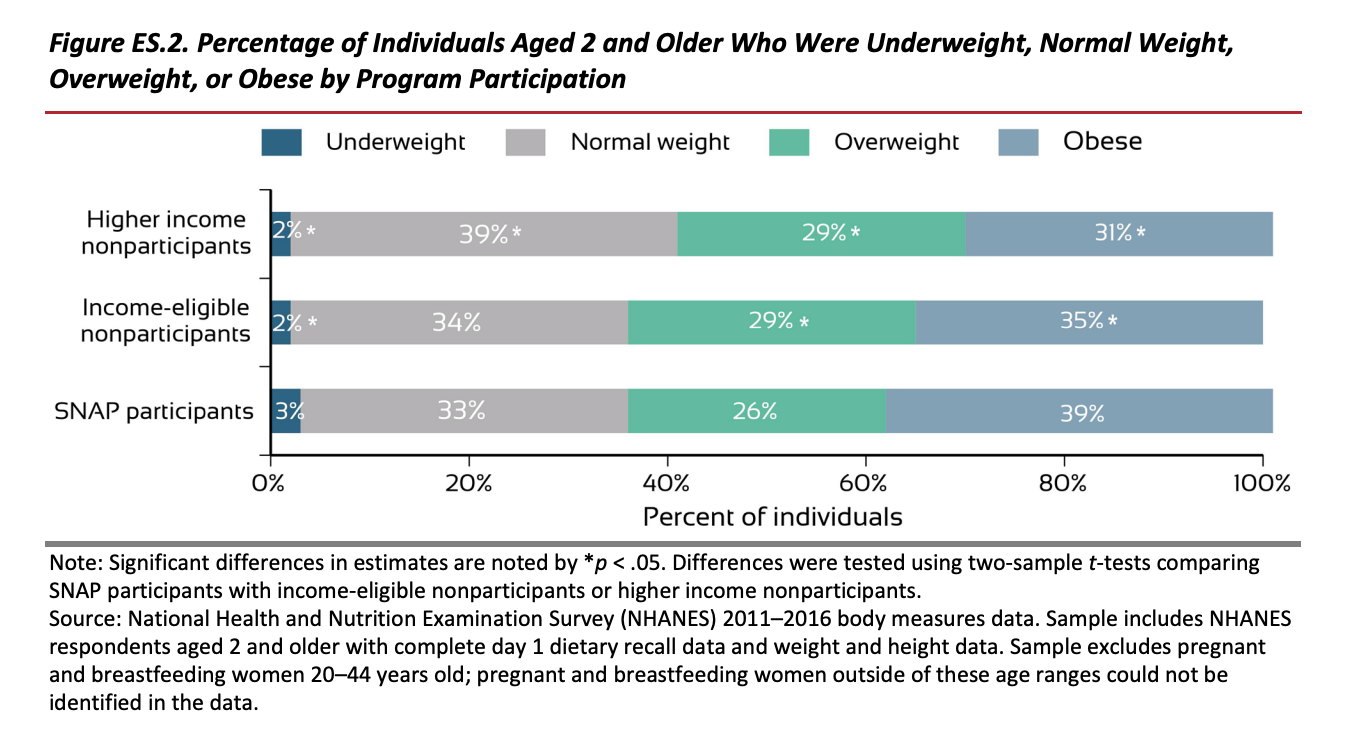
For those not familiar with welfare policy, these numbers may come as a bit of a shock. And, critically, I think the fact of that shock is as important as the numbers themselves. Because what the shock tells us is that the average weight of SNAP recipients is not nearly as conspicuous as other elements of this debate, like overwhelmed food banks. In other words, the left has a major advantage when it comes to the optics of the welfare debate. Everyone sees the food bank lines, which tend to make people more supportive of expanded welfare, but relatively few see what a typical SNAP recipient looks like, which would likely make people less supportive of expanded welfare.
While obesity numbers lead us to question the neediness of SNAP recipients, we would also do well to question the deservingness of SNAP recipients. And just as the obscurity of the average poor person makes the average taxpayer largely blind to their level of need, it also makes us blind to the personal choices they are making that might make us think twice about wanting to help them—or at least about how much we want to help.
The English polymath Herbert Spencer makes this point well in his 1884 essay The Coming Slavery:
The kinship of pity to love is shown among other ways in this, that it idealizes its object. Sympathy with one in suffering suppresses, for the time being, remembrance of his transgressions. The feeling which vents itself in “poor fellow!” on seeing one in agony, excludes the thought of “bad fellow,” which might at another time arise. Naturally, then, if the wretched are unknown or but vaguely known, all the demerits they may have are ignored; and thus it happens that when the miseries of the poor are dilated upon, they are thought of as the miseries of the deserving poor, instead of being thought of as the miseries of the undeserving poor, which in large measure they should be. Those whose hardships are set forth in pamphlets and proclaimed in sermons and speeches which echo throughout society, are assumed to be all worthy souls, grievously wronged; and none of them are thought of as bearing the penalties of their misdeeds.
Unlike with neediness, it’s hard to come up with a statistic that indicates the deservingness of the average SNAP recipient. Maybe something like credit card debt or job application rates would give an indication—high credit card debt and low job application rates might show that an individual is less deserving of welfare, and vice versa. Having said that, there is one line of evidence that is pretty damning: how people’s attitudes toward welfare change when they become more familiar with the people receiving welfare.
This brings us to Caleb Hammer.
Caleb Hammer is a YouTuber who has soared to fame in recent years. His YouTube channel, where he hosts his show Financial Audit, was launched in 2020 and currently sits at 2.8 million subscribers. On the show, he goes through his guest’s finances and gives them recommendations for how to improve their financial health. Often, his guests have made rather poor money decisions, leaving them in a world of hurt—and leaving viewers with the impression that a fair number of the poor have only themselves to blame for their financial woes, and thus maybe don’t deserve all the help they get from the government. After some leftists took issue on X with this unintended effect of the show, prompting Hammer himself to respond, Sean Fitzgerald perfectly summed up the phenomenon:


Adding to this anecdotal evidence, a 2024 study in the British Journal of Political Science found that “exposure to poor people weakens support for redistribution among the rich.” In a recent comment about this study on X, science blogger Emil Kirkegaard connected it with what’s known as contact hypothesis, the idea that contact with people from out-groups can reduce a person’s prejudice toward those groups.
Kirkegaard explained his approach to this idea in a 2024 Substack article:
In [standard contact hypothesis], the more exposure to some outgroup (immigrants, foreigners, other races etc.), the more one will truly understand them and be more friendly to them. You can see where this might apply. Suppose all you know about people from [outgroup] is the propaganda the media tells you, which is that they [are] Very Bad People. Then you meet some of them in real life, and they turn out to be OK People. The false impression given by the media was dispelled. However, what if the media tells you lies, but they are in the opposite direction? Well, then you should see the opinions get more negative, not more positive. There is some evidence for this.
…I think we can thus reformulate the contact hypothesis in the light of stereotype accuracy and propaganda. When the media gives you a misleading impression of the behaviors of some group, and you then get some real exposure to representative members of this group, your opinions will get closer to the truth, which means they will get more or less hostile depending on the direction of the media bias. I submit this is a fairly obvious model of social interactions.
Kirkegaard thus posted:


To put it starkly, if the average taxpayer lived with the average SNAP recipient for a week, there would probably be a tax revolt before the week was through.
A famous tweet that was shared in the replies sums up the controversial takeaway from this whole line of thinking:


Yet another factor that pushes the optics in the left’s favor is the relative obscurity, to the average voter, of how much the government spends on SNAP—both the total amount and how that amount has changed over time. Did you know, for instance, that SNAP spending has roughly doubled over the last 20 years? In 2007, inflation-adjusted SNAP spending was a mere $47 billion.
Suddenly, cutting it in half doesn’t sound nearly as radical, does it?
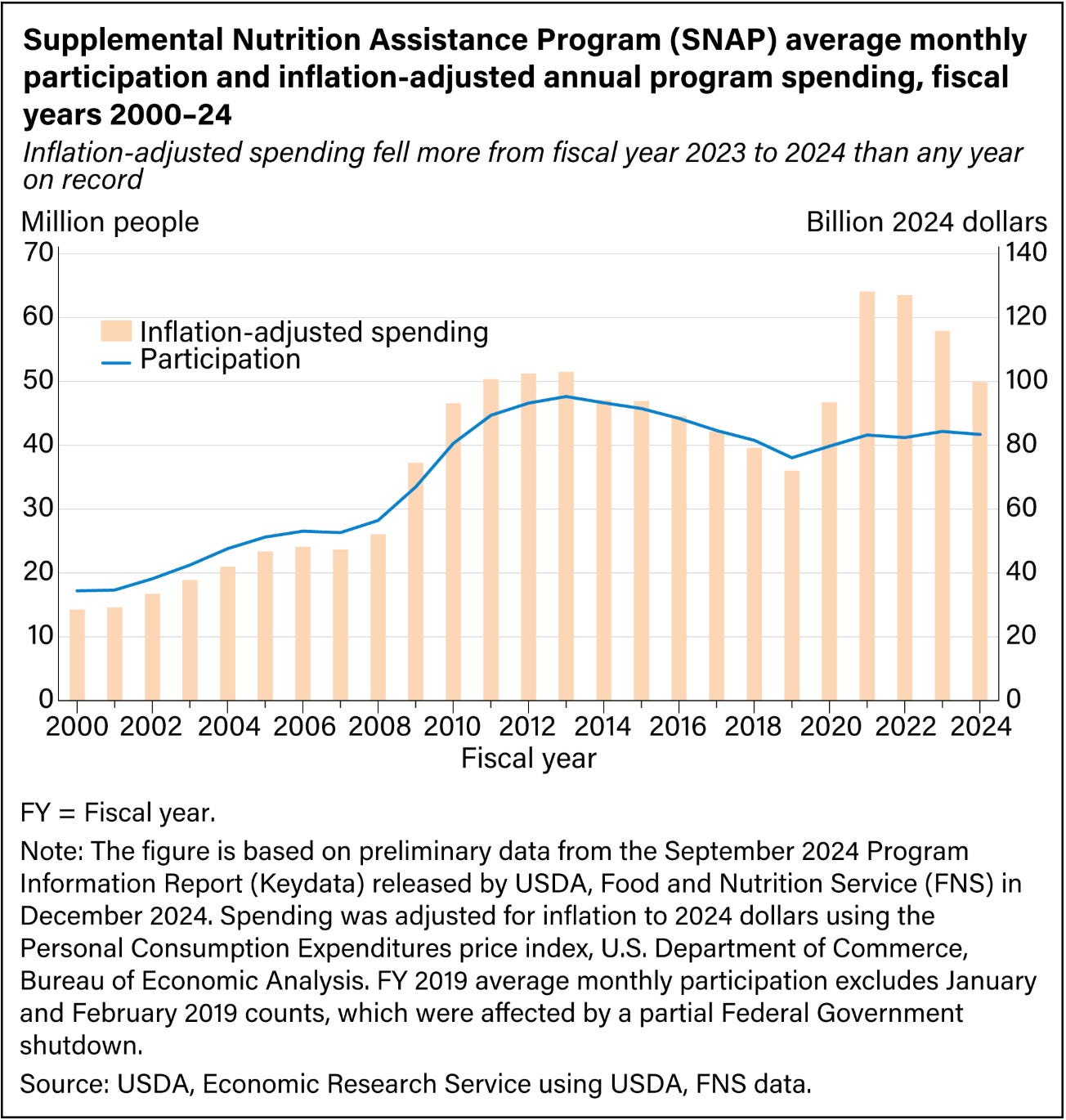
Taking all these factors together, then, the point is this: if your gut reaction to the proposed 50% cut was to dismiss the idea as ludicrous, consider the possibility that this reaction was formed by layers of one-sided, heavily biased optics, and that, were you better informed, you too would consider that kind of a cut to be, as I called it above, a reasonable initial demand.
Biting the Bullet
“But then my point stands,” Beijer would likely say. “The welfare cuts you advocate would lead to overwhelmed food banks, just like we saw in November.” Yes, they very well might—though I would stress that free market policy reforms would do much to alleviate this problem if only the leftists would allow us to make them.
But yes, even if nothing else changes, even if it causes overwhelmed food banks, we should cut SNAP significantly. Why? Because coerced charity is only justified in the most extreme cases, and the vast majority of those currently on SNAP simply do not qualify.
The fact is that the kind of people who receive government food assistance are a lot less needy and deserving than they are made out to be by the leftists who relentlessly champion their cause. There is absolutely some genuine need out there, but there is also a massive lobby pushing for ever-greater handouts to this most powerful of special-interest groups. These advocates prey on our compassion, conveniently leaving out the unflattering details about the poor that, were voters more familiar with them, would undoubtedly make many think twice about subsidizing this group to the tune of hundreds of billions of dollars.
The “callousness” behind this position is difficult to muster toward the frail, saintly single mother who is invariably held up as a representative of those in need. But it comes much more easily when you start to understand the kind of people who are actually on the receiving end of all this aid.